
What is TOON? (Token-Oriented Object Notation) - And is it actually useful?
My notes on this recent trend in the AI space

If you work with AI, you probably send a lot of JSON back and forth to different LLM models. It’s the standard language of the internet. But what if there’s a more efficient format than JSON? Something that’s cheaper (less tokens) and improves accuracy?
Enter TOON (Token-Oriented Object Notation), a project hosted on GitHub that is essentially trying to put JSON on a diet specifically for the AI era.
What is it?
First off, it looks like this:
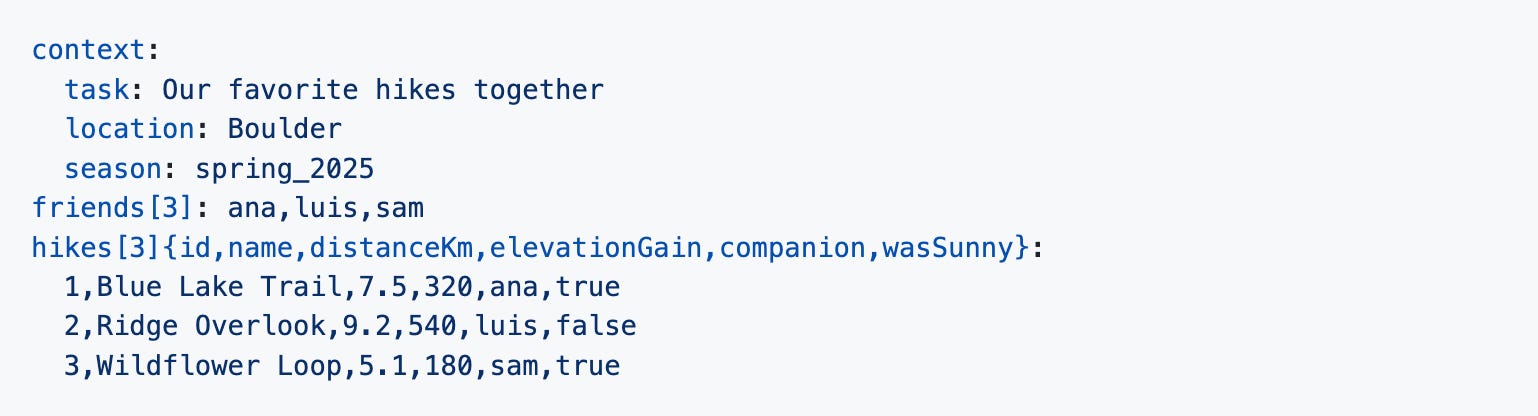
Imagine if JSON, YAML, and a CSV spreadsheet had a baby.
Like YAML: It uses indentation (whitespace) to show structure instead of curly braces.
Like CSV: It compresses lists of similar items into tight, header-based rows.
Like JSON: It is designed to represent structured data (objects, lists, strings, numbers).
The result is a data format that may look a bit more confusing to humans at first (especially arrays), but more importantly, looks “smaller” to an AI model.
Why does it exist?
On github it’s getting some traction - so it must be relevant right?

In the world of Large Language Models (LLMs like GPT-5, Claude, Gemini), you pay for tokens. A token is roughly a chunk of a word.
Standard JSON is full of “syntactic sugar”—curly braces {}, quotes “”, commas ,, and repeated field names.
JSON:
{”id”: 1, “name”: “Alice”}, {”id”: 2, “name”: “Bob”}The Problem: An AI sees every one of those quotes and brackets as tokens. If you are feeding an AI a list of 1,000 products to analyze, you are paying real money to send thousands of useless quotation marks.
TOON exists solely to strip away that “tax.” It removes the punctuation and formats the data so the AI gets the exact same information using 30% to 50% fewer tokens.
How does it fit into the bigger picture?
It is a translation layer. You aren’t supposed to rewrite your database in TOON, and you won’t see TOON replacing JSON for standard web APIs (like fetching your Twitter feed).
Instead, it fits into the “Last Mile” of AI engineering:
Your app pulls data from your database (in standard JSON/SQL).
Right before you send that data to ChatGPT or Claude, you convert it to TOON.
The AI reads the TOON (saving you money and processing time).
The AI answers you.
Is it actually useful?
Yes, but with a catch.
Where it shines: If you have uniform lists of data. For example, a list of 50 users where every user has a
name,email, androle. TOON collapses this beautifully, almost like a spreadsheet. It is arguably the most efficient way to shove a large database export into an AI’s limited memory context.Where it fails: Deeply nested, messy data. If your data is a complex tree with no repeating patterns (like a messy configuration file), TOON loses its advantage and might even be confusing.
The “Human” Factor: Because it is new, it relies on the AI being smart enough to understand it. Most modern models (GPT-4, Claude 3.5) handle it easily because it resembles formats they have seen before, but older or “dumber” models might struggle compared to standard JSON.
The Verdict
TOON isn’t a revolution that will change the web; it is a practical optimization.
If you are just chatting with a bot, ignore it. But if you are building an app that sends huge chunks of data to an AI thousands of times a day, switching to TOON is effectively a “30% Off” coupon for your monthly server bill.
Looking to the future
I can’t help but wonder - as models get cheaper, faster and smarter - how relevant this will be over longer term. Maybe in contexts where you are really processing incredible amounts of tokens - but for regular use (small chat apps) the results may be marginal.
However, I’m are always happy to see innovation in the space - kudos on the creativity 🤟
Check it out
If you are interested, go check it out: https://github.com/toon-format/toon
If you need my help on your AI challenge - hit me up:
https://blackbearlabs.ai/